 |
| You can download two pdfs and make your own Walk for Peace zine. There are instructions to make the zine linked to the page with the pdfs. |
Saturday, March 14, 2026
Free download Walk for Peace zine


Saturday, December 27, 2025
Tibetan Cham Dance Mask - a DIY free download
 |
| My first sketch of a Cham dancer. The background is a piece of discarded architect's tracing that has layers of different colors of acrylics, with a thin top layer of white applied with a rib. |
Happy New Year! This mask is inspired by Tibetan Cham dance costumes. Skeletons represent the disintegration of the body and states of mind. The stylized dance shows the liberation that follows acceptance of the impermanence of life. The dancers usually have crowns with 5 human skulls on their heads and fan shaped ornaments on their ears. I took some liberties to make the mask easier to cut out and fit in a regular sized envelope.
 |
| Tibetan Cham dance mask modeled by innocent but willing bystanders. |
There is a video of the Cham dance here.
After testing several ideas for this year's mask, this one was the most appealing. Although Tibetans don't see the skull as terrifying, I think my western feelings about death and the current state of world affairs have crept into the mask. Yes we can be liberated by accepting the idea of death. But I am also thinking about the potential death of our world and our democracy. Is this a time to dance? Probably not in happiness, but maybe in protest. Download the mask here.
I hope you all find some peace and joy in these crazy times.
Judy
Sunday, December 21, 2025
Making art under the influence of old age
 |
| Artist book page by Judith Hoffman with lots of squiggly lines, showing what a shaky hand can do. |
I originally started this post to be about aging and making art. There are physical limitations that creep in. But it also became some musings on aging and how I try to accept that.
Much to my surprise, I turned 80 this year. Even after seeing my parents and in-laws age and die, I'm surprised at how hard it is. Of course I have medical things to deal with, but the physical slowing down is what gets to me. I am not very bothered by my wrinkles and sagginess. After all, I am lucky to be alive, to have a home and food, and to have family and friends who love me. And lucky to be able to work on projects that are engaging. But the lessening energy, the physical struggles, are disheartening.
I have had a tremor in my hands for years, it's getting worse. I'm left handed and the left hand tremor is more pronounced than the right. Sometimes when I draw my lines are wavy. It can be frustrating. I try to regard the wavy line as a feature. At times it can blend in well with my drawing style, which is somewhat loose. Warming up helps, finding the right posture helps. Using scissors to cut out things has also become harder. With small things I cut right handed and brace my right hand against my left as I cut. It's much harder to cleanly cut larger things, where my hands can't brace against each other. I think getting tired makes the tremors worse. (My doctor says there is no physical ailment, it's just age.)
 |
| Detail from drawing showing squiggly lines produced by shaky hand. It's a consequence of getting old. They don't always work for me, but here they do. |
I have less energy than I used to. I have always been slow to complete projects, now my books evolve at a snail's pace. In part because they are more complicated, but I also don't get in the studio as much. Many household tasks are ignored. I sometimes lose interest in an art project before it's finished. I am, as always, easily distracted, often more interested in doing something new than repeating what I did last month. It does help to try to make small progress on a project, just a little drawing in a background can re-ignite my interest in the pages I am trying to complete. There are tricks that most artists know, spending time cleaning in my studio. And spending time with tools and materials, even if it's just to doodle. It also helps to make collage papers, or to cut out things I might use in collage.
I must say, the process of drawing and collaging is still as alluring as ever. Once I start I am engrossed for several hours and end up feeling so rewarded.
As I have aged my priorities have changed. I care more than ever about the process and less about showing the books. Some people want to leave a mark before they die, but that's not me. I would like to have some of my books in public collections, but haven't pursued that much. And I feel that when I'm dead I won't really care anymore. If I spend more time making things and less on entering shows, that's the best way to spend my time. I want to enjoy my life now.
 |
| Page from an artist book in progress by Judith Hoffman. |
My dad used to say "it could be worse" whenever he mentioned his physical ailments. Meaning he could be dead. I think of him often, and agree completely.
"... as we move through our lives, the way our bodies change, and ultimately death, can be our teacher. Forgiving our bodies - for dying, for aging, for becoming sick - can feel impossible, even radical, but it's essential if we want to fully appreciate the time we have. We can love our lives, even while knowing that one day they will end." Martine Panzica, from Lion's Roar, November 2025.
Happy Holidays to you all. I hope you will be content with life and feel productive in the coming year.
Judy
Tuesday, July 15, 2025
Fixing a big mistake
 |
| I mostly like this page, but the arm of the woman behind the large hand is bothering me. |
For all the wonky drawings that I accept as fine, this one was not fine. I spent 3 weeks thinking about what to do (and working on other pages). I could just glue more eco dyed paper over the part I didn't like, but it would stand out as being glued on.
 |
| Drawing over the arm with white ink made a mess, but it did lighten those lines. |
 |
| I made a stencil and printed a thin coat of pale titan buff on the areas that were bothering me. |
 |
| Then I glued coffee splattered abaca paper on the offending area. |
 |
| A new arm is collaged on. Maybe it's too short? I think his arm and shirt need a pattern. |
 |
| Sometimes this looks okay, sometimes I am not happy with it. I'll put it away for a while. |
Here I have extended the aura around his neck. I also added shrubs and another arm for the woman. I feel the sleeve needs something. Check out this recent post Jane Davies recently did about a change she made in one of her paintings. She has a very good attitude toward making changes, and she is skilled at it. I agonized over every step here, feeling bad that I had made this mistake. I need to take Jane's approach. And if I can make mistakes and correct them I will feel more okay with experimenting.
Tuesday, June 17, 2025
I eat lettuce and milk for breakfast
 |
| A page from my handmade book My dreams defy analysis. ©2024 7.75 x 5.75 x 1 inch (closed). |
I am emptying a big bowl of lettuce and milk onto the ground behind our house. I was eating it for breakfast but a lot of the lettuce was old and brown and yellow. I don’t want any more. I see a tiny man about 6 inches high ride by on a tiny horse. He is at the foot of the hill. He goes so quickly then he disappears near some rocks. When I walk over to see where he has gone, at first it looks like he disappeared into some huge boulders that make a wall, but then I think he has climbed a small ravine that goes up the hillside. When I look up I see he has become huge, maybe 12 feet tall. He is a bulky guy, very thick in legs and arms. As I watch he leans over and becomes a huge boulder on the hillside. No one would ever know it’s a man.
The man was so real in my dream. And I felt like I had seen a marvelous thing. Lately I have been having a lot of stress dreams, searching and not finding, worrying about things, so this felt like a real gift. The image is from my book "My dreams defy analysis."
Friday, October 18, 2024
Writing a Meaningful Artist's Statement with Jane Davies
 |
| Fluke, 1987. 7 x 5 x 1 inch closed. Collage and acrylic paint on watercolor paper. |
I have been anticipating this class for months. Originally I thought I could write one really good statement and cross that off my to-do list. It's not that easy. Jane suggests a new statement for every new body of work. Or maybe every 6 months. It does make sense. As we look at what makes a good statement I realize I would need to re-write it every time my work changes. With Jane's guidance we dug into ourselves and tried to explain what was important to us about making art. It was hard work, I usually just write whatever comes into my head. I ended up with 17 pages of text and notes. And three paragraphs that work well.
 |
| Duck Dreams, 1987, 7 x 5 x 1 inch closed. Collage on watercolor paper, acrylic paint. |
At one point I went back and looked at all my earliest books to try to explain why the book format was so important to me. I think my interest in artist's books goes way back to a text book for an art class I took around 1965. There was a photo of a handmade book that had a glove stitched to one page and a ladder on the opposite page. This whole book as a revelation - it had a lot of art that I would not have defined as art. And I loved a lot of it. It was eye opening. I figured out which book it was and ordered a used copy. I'm very curious to see that again.
 |
| In My Dreams We Travel in Boats, 2008. |
So far I have 17 pages of rumination. Out of that has come a statement that feels authentic to me, it's certainly the best one I have ever written. I have learned more about myself, and I know more now about what I want to say in my art. I would definitely recommend this class to people who are willing to put in the work. It's like a college level class, with time consuming homework. But it only lasted 5 weeks, with more time to discuss for another 3 weeks. The more time and effort you put in, the more you will get out of it.
 |
| Fluke, 1987, 7 x 5 x 1 inch closed. One of my favorite early books. |
I wanted to take the time to look closely at everyone else's work and writing and try to respond to it. Partly because I don't feel I'm very good at looking at art in general. And I'm often not able to articulate what I feel about it. As people's statements came into focus they helped me to see their art in a new light. I had never realized how important and helpful a good statement could be.
And here is the statement:
Dreams have been a major interest all my life. When I was around eight I had a dream that terrified me. Little creatures were quickly lifting me up in the air, my family was far below, calling and reaching up to me. But the creatures carried me higher and higher, I couldn’t get away. I woke terrified, I had the feeling that dreaming was another world, as real as our “waking” world. I did not want to go back there for months.
I have kept a dream journal off and on since I was in my 20’s. When I went to art school in my 30’s I became consistent, and started using the dreams as inspiration. When I’m dreaming I can draw aside a curtain in my mind and see more of what’s going on there. I don’t understand most of my dreams. I always write them in the first person present tense and end with “I wake.”
Books hold stories and are the perfect containers for dreams. They can be held in my hand, pages are turned, the images are sequential and so influence each other more. Books feel personal. I believe books can contain answers to all the big questions, where did I come from when I was born? Where will I go when I die? I just have to find or make the right book.
Sunday, September 08, 2024
I find a penny
 |
| Dream Intruder artist book 7.75 x 6 x 1 inch. Acrylic ink, found papers, dreams. Drumleaf binding, eco dyed papers. by Judith Hoffman |
I’m with my family. We’re deep in the woods at first. I find a penny. While we talk someone dies. We have to go somewhere else, we travel in a coach with horses. I find a dime. Mom dies on some steps outside a house. She is buried in the wall of the house. Then I find a quarter. That seems big. I think it means I will die. But then people start coming back to life. Mom comes back to life on the steps outside the house. I wake up. There is a nickel on the floor of the laundry room. I don’t want to pick it up.
Wednesday, April 17, 2024
Momigami experiments with hand cream
 |
| Momigami experiment - left is the momigami, right is the original inkjet print on architect's tracing paper. I was surprised the momigami got much lighter than the original. |
 |
| Momigami paper on left after rubbing on some acrylic paint or hi-flow inks. |
(All images will enlarge - just click on them.) My friend Eileen of the Good Junk Sanctuary came over and showed me how to make momigami. It's something I have been curious about for years. We made a couple of pages while we talked about art and life. She mentioned that you could use hand cream, cooking oil or a gel made from konnyaku powder that is intended for momigami. After Eileen left I experimented with hand cream. (There are lots of videos online for making momigami.) I'm using Vaseline Intensive Care but I think hand creams are pretty much all the same. I first made a number of pieces of momigami from different papers. I let them dry overnight, the hand cream seems to go away. Maybe it's absorbed? The next day I rubbed acrylic paint diluted with glazing medium or hi-flow paint on them. All the paints were very thin, I wanted a transparent layer that wouldn't obscure the original patterns. My goal is to have interesting collage papers. All the papers became softer, and heavily wrinkled of course. The more fragile papers developed little holes and tears along the edges which I love. Rubbing the papers with paint did smooth out most of the physical wrinkles but emphasized the visual texture. At times the backs are almost more beautiful than the fronts.
 |
| The section of a brown envelope on the right with the arrow head is the momigami. The paper had already been printed with some acrylic paints on a gelli plate. The light spots are titan buff, a fairly opaque paint. |
 |
| The next day the momigami paper was rubbed with acrylic paint. Not much change, but the more opaque titan buff spots stand out beautifully from the ground. Hard to see the effect in the photo. |
 |
| The momigami piece is on the right, the original paper was printed on the gelli plate. I was surprised at how much lighter it became. This is also architect's tracing paper. It's very tough. |
 |
| I painted some thin blues and sepia toned paints over the momigami sample. |
 |
| These two pages came from a magazine. The small figure on the right looks particularly good for collage. |
 |
| The pages were then painted with blue and golden brown acrylic paints. |
 |
| I like the network of lines caused by paint sinking into the wrinkles. These will make inspiring collage materials. |
 |
| On the left - momigami on a gardening magazine pages. The ink came off the page and smeared around some, making my hands inky and the page look dirty. |
 |
| This was another gardening magazine page that was fragile. To strengthen it I tried to coat it with mat medium on a gelli plate. The paper stuck to the plate so I let it dry then coated it with more mat medium and laid a piece of architect's tracing paper on top. When that was dry I was able to peel the whole sheet off. What I have is some beautifully grungy text and plants. |
 |
| Bits of a page that fell apart. I love the cracks and the subtle colors. |
 |
| The backs of the previous bits of paper. The visual textures and colors are lovely. |
Tuesday, April 16, 2024
Drab Reality
 |
| Drab Reality - artist book made by Judith Hoffman, 2022. Pages 1 and 2. Collage, drawing, gelli plate printing. |
Drab Reality, handmade one-of-a-kind artist book, 2022. 3.75 x 5.25 x 1 inch. Drumleaf binding. See still photos of all the pages on my website. I have been struggling to explain this book. Its version of reality is definitely not drab. But it's also not explainable. This book evolved from some experiments. I tried preparing the backgrounds with the gelli plate. I have also been experimenting with drawing on transparent papers for collage. There are more details on my website.
Drab Reality will be in the Puget Sound Book Artists Member's exhibit at the Collins Memorial Library June 4 to August 1, 2024. And at the Evergreen State Collage, September 29 to December 20, 2024.
Yes, I made this book two years ago. I have been slow to get my photography set up back in place. I'm not good at photography, so it takes me hours and hours to set up, take some sample photos, make adjustments, re-learn the camera settings, etc. etc. I think I just wanted to go ahead and start another project when this book was finished.
Wednesday, February 28, 2024
Testing papers for transparency
 |
| Transparency tests. The tests are laid on a piece of black and a piece of white paper. Each is coated with Golden mat medium front and back up to about the halfway point. The papers are: 1. An unknown paper recommended, but discontinued. I have a stack. 2. Calligraphy paper. 3. Abaca from Talas. 4. Wet strength tissue. 5. Architect's tracing paper (Dick Blick calls it Canary Sketching and Tracing.) 6. White Kozo from Hiromi. 7. An old pad of forms used for dispatching or tracing trains. 8. Colors of the Rainbow tissue paper. (the color is Kraft) Drawings on #1 thru 6 are with .005 micron black. #7 and 8 are with 01 Microns. The image will enlarge. |
I like to layer papers when I collage, I want the papers to be somewhat transparent or translucent. My drawings are often done on architect's tracing paper. I coat it with Golden mat medium to make sure the ink doesn't smear in the collage process. Then I collage the drawing to the substrate. The mat medium does help to make the papers translucent.
 |
| Transparency test. Colors of the rainbow tissue paper in soft ivory. The figure was drawn on the paper, coated with mat medium, cut out and collaged to eco-dyed paper. The soft ivory pretty closely matches the substrate paper. The brand Colors of the Rainbow is archival and comes in many colors. The paper is not strong when wet. |
I have been testing papers lately, looking for other fairly transparent papers in tones I like. I tested all the likely looking papers I could find in my studio. After drawing on each sample I coated it front and back with the mat medium. Below are some drawings and collages I did to further test some of the papers I liked.
 |
| Old train dispatch or routing paper with drawing. Coated with mat medium, cut out and collaged to eco-dyed substrate. I don't really know how to describe this pad. It's clearly associated with trains. I would love to find more, but I assume it's not archival. |
 |
| The figure was drawn on Abaca paper from Talas. I believe it's 9 gsm. This is the thinnest paper I tested. It works very well, although it's a little hard to drawn on. It's also my favorite for having the paper disappear. I think it would be beautiful for mark making. |
All these tests were inspired by Sally Hirst. She has a blog post here about making papers transparent. And a YouTube video here. Her process is different from mine - she spritzes her papers before coating with medium. And she uses a different medium. Sally does test an even thinner Abaca which has to be ordered from Etsy. I found that too thin to draw on, but it would be great for mark making.
Saturday, February 10, 2024
A dream about a drawing class.
 |
| Quick sketch of me in the dream, done right after writing the dream down in the dark. I was lying down in bed. |
I sign up for a drawing class. The first day I'm a minute late. The instructor has locked the back door to the room so I have to go in the front one. He makes a comment because I'm late. I am embarrassed. The second class I'm in the bathroom when the bell rings. I have already gone in and left my purse on a desk. But when I go back there is a woman - middle aged, white hair - writing formulas on the blackboard. The teacher is working on some papers and doesn't look up. So I sneak in and go to stand in the back, in the doorway of a closet, trying to not be seen. I'm hoping to get to my seat during a break. A few other people come to stand in the back too. A guy with sandy short hair starts talking to me. He says something about my dog Toby. Part of the time I can't understand him. I ask him to repeat but still can't make sense of what he is saying. Toby is his dog, a rescue who took a liking to me at another time. I wonder if the woman at the blackboard is writing fire extinguisher formulas. Over time she covers a blackboard that has 3 big panels and extends all the way across the front of the room. The class is silent and taking notes. When will we draw? I don't have a drawing pad. Can I find Jim and get some money to buy a pad? I can't find my glasses so I have to wear the red weak ones. They look like red goggles. I feel very self conscious. I wake.
Friday, January 19, 2024
A Krampus Mask you can download and make yourself

For Christmas cards last year - in 2023 - I made a Krampus Mask. You can go here, download a pdf, and make your own mask. If you don't know who Krampus is - He used to be Santa Claus's sidekick. Maybe a balancing of good and evil? He seems to have been part of pre-Christian Northern European customs. I believe he was called Knecht Ruprecht in parts of Germany. There was a fad for Greetings from Krampus postcards for awhile - and now there are modern, very creepy versions. Check wikipedia for more info.
 |
| The mock-up Krampus masks and sketches. |
I started with several mock-ups and a quick sketch - trying to get the eyes in the right place and correct proportions. The sketch ended up looking sad rather than scary, so I took it into Procreate on my iPad and made some alterations.
 |
| After altering he may be a bit more scary, or angry. I'm not fond of creepy. |
Enjoy your new identity. I hope you all had a great holiday.
 |
Friday, January 06, 2023
Is there one correct way to do blind contour drawing?
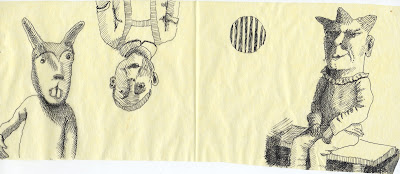 |
| A piece of tracing paper with blind contour drawings. These sketches go into a box to possibly be used in collage later. None are considered finished at this point. They will be torn away from the main sheet and used individually. It's a low pressure way to work. |
There are a number of ways that artists do blind contour drawings. In general the purpose is to strengthen observational and drawing skills. Most artists don't consider the final drawings to be a finished, presentable product. I find it a very useful way to generate sketches that are quirky. I consider some of them finished drawings that may end up in my collages. It's also a way for me to break away from my inclination to draw realistically, which drives me nuts.
 |
| Blind contour drawing on collaged background, 5 x 7 inches. |
I think this is the method that most art teachers use:
(This would likely be using a large sheet of paper.)
- Position yourself so you can see the subject, but not your paper.
- Fix your eye on an edge in the subject.
- Draw a continuous line on your paper, don't look at the drawing. Slowly follow the edge or contour with your eyes and the tool.
- Imagine that the drawing tool is touching the subject.
- Sometimes a timer is set.
 |
| Blind contour drawing on a collaged background. 5 x 7 inches |
There is no reason why you have to follow these “rules.”
My favorite method is to draw fairly fast. My drawing are small, between 3 and 6 inches high. They usually take about two minutes for the blind contour drawing. I often draw an area - an eye and the nose for example - and then lift my pen and start the second eye somewhere else. This can create interesting disjunctions. If I have done five or six drawings without looking at the paper when I lift the pen, and I don’t like any of them, then I would probably look at the paper to move my pen. I don't try to get it in the perfect spot, just in the ballpark. If I’m not looking, eye glasses can be split into pieces that may not look good so I usually draw them all in one line. After I have five to ten quick drawings, I add hatching to my favorites while looking at the subject and the drawing. I always feel free to enhance areas I like - like the eyes. Hatching in general adds volume and character. It also sometimes adds to the oddness of the drawing.
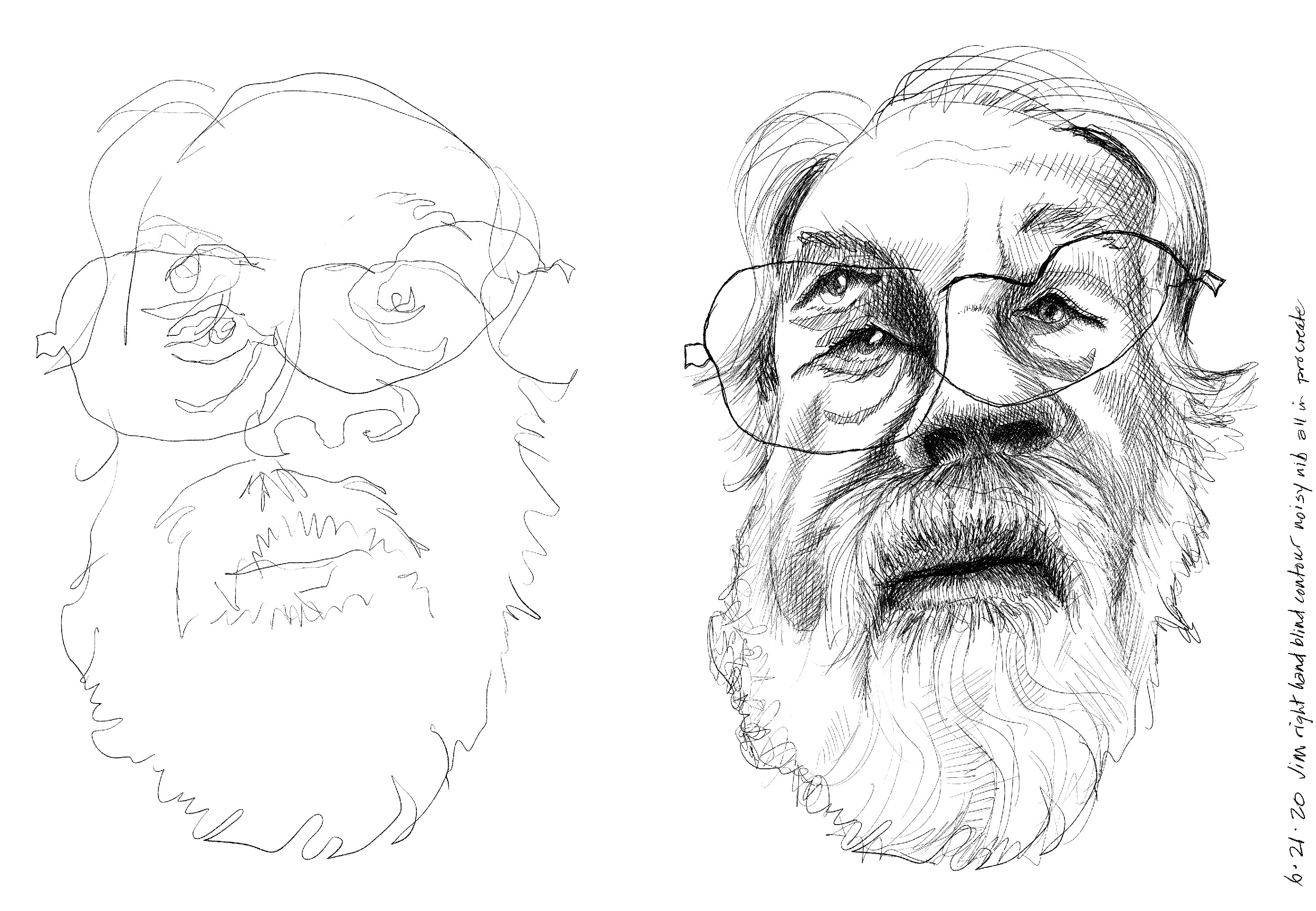 |
| Blind contour drawing done on iPad with Procreate. I lost track of the eyes so there is an extra. Another layer was used to add hatching while looking at the photo. |
 |
| This is a two page spread from my sketchbook. The sketches were all done from the same photo. With eyes closed, I drew one face, opened my eyes and started the next one nearby. The hatching was added with my eyes open. |
Possible variations:
- Use non-dominant hand.
- Or switch hands mid-drawing.
- Lift the drawing tool, don’t look at the paper to place it again.
- Or lift the tool, look at my paper to place it again but immediately look away.
- Draw fast.
- Draw very slow.
- Make hatching or scribbling marks as I do the blind part of the drawing. They have a different quality than the more deliberate ones I usually make while looking.
 |
| Feel-draw sketch, hatching added in ears, around nose and mouth while looking. |
Another closely related drawing method is what I call the feel-draw. I saw this in a drawing technique book, but can't find it now. I feel my face and draw what I feel. Ups and downs, bumps, etc. It's another way to get an interesting drawing with distortions. The variations apply here too. I like the effect of doing some blind hatching or scribbling to mark the lower areas like ear holes. So far these haven't made it into collages, they seem too weird. But as I say that I realize I need to use them.
 |
| Hands can be very interesting using blind contour methods. |
 |
| Working in Procreate on my iPad, I have a black layer behind the transparent layer I'm drawing on. |
When drawing on an ipad, I put a layer under the layer I'm drawing on that is the same color as my drawing tool. When I am drawing with a black pen, I draw on the top transparent layer. There is a layer below that is also black. That black layer won't be turned off until the blind part of the drawing is complete. I sometimes use a third layer to add the hatching.
 |
| Another group of drawings on tracing paper. I probably won't use most of these. I only like one right now. |
Subscribe to:
Posts (Atom)


